 The Tech Interactive End of Year Appeal




Real Attribution for Growing Brands and Nonprofits
If you run a growing business or lead a nonprofit, you have likely felt the pressure to justify every dollar in your budget. You launch campaigns across Google, Meta, email, and direct mail, but when the performance reports land on your desk, you are often left looking at a pile of confusing metrics instead of clear financial growth.
Clicks, impressions, response rate, and video views feel productive, but they do not automatically pay the bills or fund a mission. So how do you actually know if your marketing budget is moving the needle?
The answer comes down to understanding strategic attribution and bridging the gap between platform-level marketing conversions and your actual bottom line.
Agency Conversions vs. Institutional Conversions: Clearing Up the Confusion
What exactly is a conversion?
To a digital marketing agency running an ad platform, a conversion might mean an ad click, a whitepaper download, or a link tap. To your leadership team, an actual conversion is a booked service call, a new patient visit, a signed contract, or a donor giving to a capital campaign.
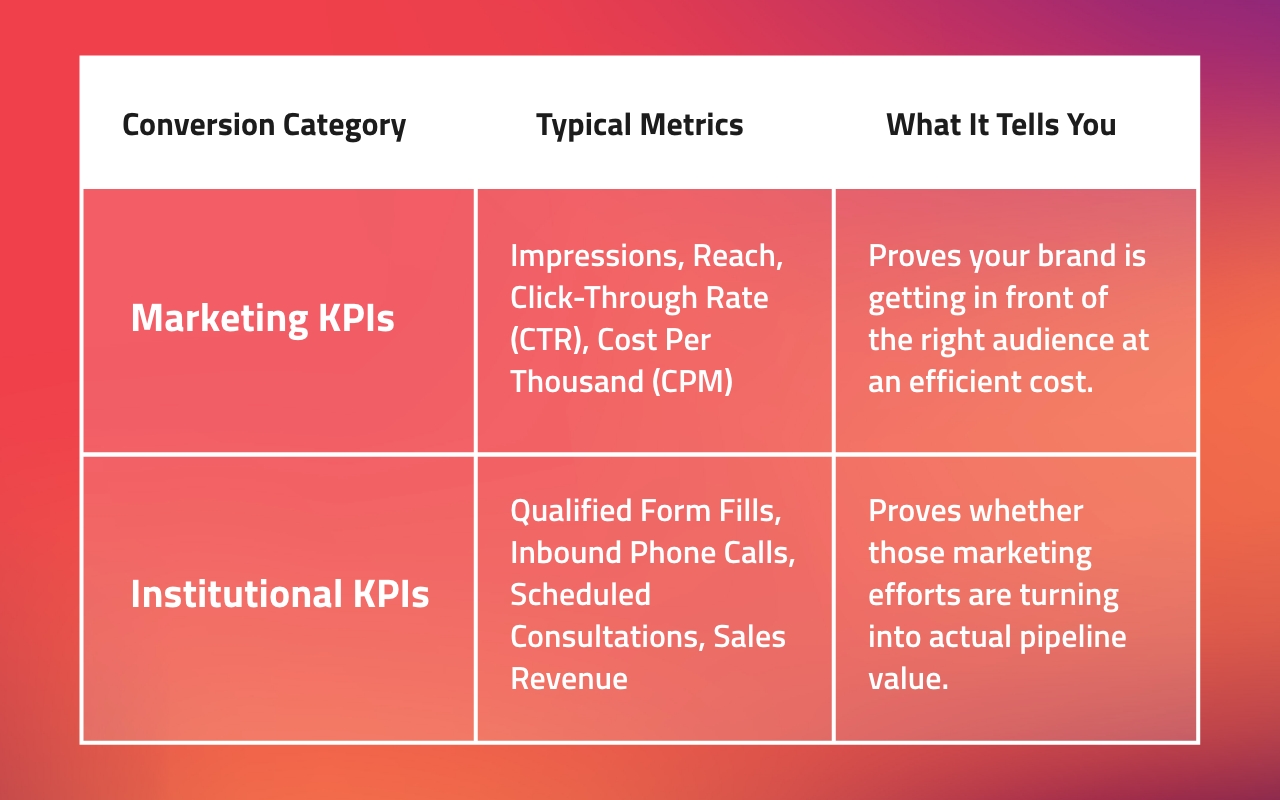
Top-funnel engagement is essential to build awareness, but it is only half the picture. True marketing ROI happens when you connect initial ad costs to final revenue using unified tracking systems.
The Customer Journey Isn’t a Straight Line
A prospect rarely sees one ad and buys immediately. A potential customer might see a social media video on Monday, search for your brand on Google on Wednesday, and finally call your office after receiving a targeted email two weeks later.
This non-linear path is why strategic attribution matters. Strategic attribution maps business value across every touchpoint in the buyer’s journey, showing how multiple channels work together to create a single conversion. “The rule of 7 really isn’t valid anymore,” says Lou Leonardis, Co-founder of Trillion. “It’s more like the rule of 70 … we see so many more exposures digitally because they are easier to distribute, and we see a much higher volume of ads, in many new formats.”
Beyond traditional touchpoints, modern buyers are increasingly turning to AI engines to research services before ever visiting a website. Optimizing your website for Generative Engine Optimization (GEO) alongside traditional search can help you give clear authority signals to AI platforms, so that your organization appears in front of decision-makers at the critical moment of intent.
Connecting all these evolving digital touchpoints to actual business growth requires clear analytics. When you set up tracking systems like dynamic call routing, CRM integration, and campaign-specific event tags, you remove the guesswork. You stop asking if your marketing works and start seeing exactly which channels bring in your best clients.
Real-World Impact: Turning Data into Measurable Revenue Growth
Campaign data can help eliminate budget waste and scale real revenue.
Trillion’s client, HVAC provider Meyer & Depew Heating and Cooling, wanted to transition their traditional marketing into a high-performance local digital lead generation engine and see which online ad dollars were driving real service calls.

Trillion’s strategy combined targeted Google Search, custom dynamic Meta video ads featuring owner caricatures, Nextdoor campaigns, and localized media. Switching from broad offer setups to granular, audience-first targets narrowed the targets and significantly reduced budget waste. CallRail lead tracking then logged every inbound inquiry. The strategy boosted their bottom line, and they were able to track how their dollars were spent to make that happen.
- 350% increase in Google Ads Click-Through Rate (CTR) year over year
- 2.49+ million targeted digital impressions across key regional service area
- Leap from 1,375 to 2,195 qualified inbound leads
- $300,000+ in new incremental revenue generated directly from search performance
By connecting initial campaign touchpoints directly to closed service calls, Meyer & Depew gained clarity on their return on ad spend.
Digital marketing breaks down the guesswork. At Trillion, we use it to give both B2B and B2C clients a powerful advantage: complete visibility into which campaigns are pulling their weight and generating real revenue.
Expanding Patient Reach and Scaling Revenue in Healthcare

Trillion’s client Summit Physical Therapy was looking to expand patient volume. They partnered with Trillion to refine their SEO, revamp landing pages, and launch targeted ads for specific health conditions, and every campaign was tied directly to patient acquisition metrics. By tracking dedicated landing pages, search rankings, and referral channels, the practice saw a 94% increase in new patients from digital channels and a 22% total lift in overall practice revenue. Connecting digital visibility directly to appointment bookings proved exactly where their growth was coming from.
Three Steps to Prove Your Marketing Budget is Working
Whether you’re using an outsourced CMO and marketing team, or full-time in-house marketing staff, to truly understand your ROI, your growth strategy needs to focus on three core elements:
- Establish Unified Metrics Early: Define separate KPIs for top-funnel awareness and bottom-funnel revenue. Make sure your internal team and external partners agree on what defines a win.
- Implement Call and Lead Tracking: Use software tools to trace inbound phone calls, web forms, and consultations back to the specific campaign or channel that generated them.
- Analyze and Pivot in Real Time: Raw data is only useful if someone is reviewing it regularly. Adjust targeting, creative assets, and spend allocation based on performance trends to keep costs low and lead quality high.
Frequently Asked Questions
Why shouldn’t I evaluate my agency on closed sales alone?
An agency’s core job is getting qualified prospects to raise their hand via phone calls, form submissions, or web visits. Closing those prospects into paying clients relies on your internal intake process, sales response times, and pricing models.
How long does it take to get reliable marketing attribution data?
While initial ad clicks show up immediately, building an accurate multi-touch attribution model typically requires 60 to 90 days of consistent data collection across your campaigns.
Get Clear Attribution Built Around Your Real Business Goals
Tracking marketing performance does not have to feel like solving a puzzle with missing pieces. If you are ready to start scaling your leads with full transparency, call Trillion at 908.219.4703 or reach out on our site to start getting clear attribution. Let’s take a look at your current campaigns and build a roadmap that turns your marketing budget into dependable business growth.